KEEP EXECUTING / THE WORK CONTINUES
Reps. Review.
Repeat.
Understanding is one skill.
Execution under risk is another.
I can understand a setup and still hesitate, enter early or interfere with the stop when money is on the line. Learning to wait, size correctly, act on my conditions and accept invalidation took practical work. This page is where I turn the read into a repeatable procedure and review what I actually did.
FIELD PROCEDURE / USE THE SAME FOUR MODULES
Four modules.
One operating system.
The chart gives me an idea to assess. The procedure governs how I act on it: qualify the setup, complete the risk checks before any order, execute the plan and review the decision afterwards.
MODULE 01 / CONTEXT & PREPARATION
Understand the conditions before acting.
I identify the market state, the relevant structure and where I want to observe price. The auction logic applies from the 1 minute to the weekly; the timeframe changes the context and pace.
MODULE 02 / EXECUTION
Qualify the entry. Keep the decision conditional.
I trade supported lows and failed highs through the same auction logic. This module qualifies the setup; risk must be defined before I place an order.
MODULE 03 / RISK & STOP RULES
Protect the capital and the decision-maker.
For perpetual daytrading, I start with the invalidation. Size follows the stop. I do not move the stop to justify a position I want to take.
MODULE 04 / REVIEW LOOP
Turn an execution into something I can learn from.
The outcome tells me what happened. The review asks how I operated. I look for repeated strengths and mistakes in my own execution.
A checklist records your thinking. It does not validate a trade or remove uncertainty. Checks stay in this page until you reload.
MAKE THE PROCEDURE YOURS
Write what you do.
Make it reviewable.
You can use the structure even if you trade a different setup. Keep context, execution, risk and review connected. Write conditions you can recognise on a chart, then assess whether you actually followed them.
RECORD THE WORK
One setup.
Your own evidence.
I keep the setup simple enough to repeat and the record honest enough to learn from. More trades on their own prove nothing.
- 01
Learn to recognise it.
Use TradingView to mark the level, sweep, close back inside, invalidation and objective. Hide future candles when reviewing history. Learn what qualifies and what you would pass on before worrying about clicking an order.
- 02
Learn the controls.
Paper trading is useful for getting familiar with an exchange: placing, editing and cancelling orders, setting stops and closing a position. It teaches the interface. It does not reproduce how I feel when my own money is at risk.
- 03
Learn the execution.
For me, that learning came from a small live account and small real amounts. The feeling of a real loss changes the experience. I log the decision, the execution and the emotion, then work on one mistake at a time.
That is my learning path, not a requirement to trade live. Real money can be lost even at small size. Recognition work, exchange practice and a profitable live record are three different things.
Give the review something to work with.
Keep one version of your rules. Record entry, stop, targets, risk, fills, costs and net R, with before-and-after charts. Include passes, losses and rule breaks. An initial 50–100 observations or trades gives you a starting point for review, not proof of an edge. If you change a rule, note the change and assess it on fresh examples.
Small account. Realistic expectations.
A sensible percentage result can feel small in euros. Forcing more trades or more risk to make the amount exciting changes the process. I track R and execution quality alongside money. At the learning stage, the account is there to learn the work; it does not owe you an income. I grew beyond that stage over time, rather than asking a small account to carry my living costs.
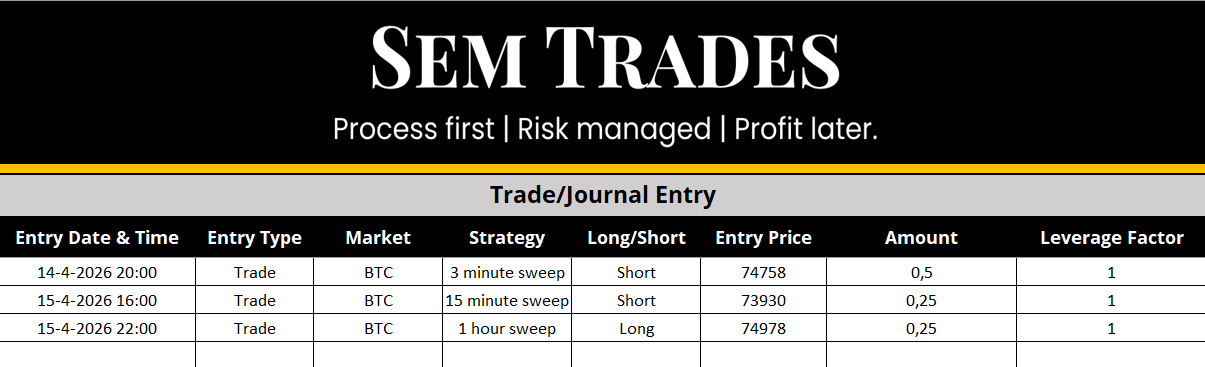
No course. No signup. Just the work.
Updated Excel trading journal · 10.6 MB
EXECUTION / WITH THE ENDING STILL UNKNOWN
No perfect trade.
Protect the next decision.
I still get it wrong. I can enter early, hesitate, exit before the rest of the move or watch price run without me. I trade this framework profitably on average, while continuing to work on those mistakes. My job is to execute under risk, sometimes while uncomfortable, and keep the damage contained.
Hindsight has extra information.
After the move, I can draw a perfect-looking entry and exit. Live, the candles to the right do not exist yet. I judge the decision against the information and rules available then. Taking planned profit before price runs further is not automatically a mistake. Breaking my entry rule is still a mistake even if it makes money.
One imperfect trade is enough.
A missed entry does not justify a chase. An early exit does not make the next setup valid. A loss does not create a job to win it back. I record the mistake, respect the stop conditions and give the next decision its own assessment. Accepting imperfection means reviewing it honestly; it does not excuse repeating preventable rule breaks.
What could I reasonably see and do at the time? Was this normal uncertainty, a poor read or an execution mistake? The review below turns that answer into something I can work on.
TURN THE RECORD INTO A DECISION
Review the pattern.
Change one thing.
A journal is useful when it changes what you notice and how you act. I do not want a folder of screenshots that I never open again.
- 01
Review the read and the execution.
What did I see with the information available then? Did it qualify under my rules? Hide the later candles and reconstruct that decision before using the ending to judge it. Then: what did I actually do with the entry, size, stop and exits? A valid loss, a misread and an execution mistake need different responses. A win alone does not answer those questions.
- 02
Look for a repeatable difference.
Compare the conditions you recorded: local or structural level, first hold or later entry, room to target and costs. Review passes too. Do not move the goalposts after seeing what the market did.
- 03
Write a correction you can observe.
“Be more disciplined” gives me nothing to check. “Mark the first opposing level before considering entry” does. Choose one useful correction, date the new version and keep the old results attached to the old rules.
- 04
Give it fresh evidence.
Apply the correction to new observations. Check whether execution improved and whether results after costs support the idea. If the sample is small or conditions changed, keep the conclusion provisional. Do not rewrite the whole framework after every loss.
What repeated? What will I change or keep? What evidence would make me reconsider?
Connect the review to your development →THE PERSON OPERATING IT
Work. Trade. Invest.
Have a life.
A working procedure needs to fit the time and attention you actually have. Keep trading, investing and everyday responsibilities clear, so a problem in one does not quietly rewrite the rules of another.
Short-term BTC and ETH trades have their own account and rules. An investment is not a failed daytrade with a new label.
I invest separately for the long term, including broad global index exposure and Bitcoin. The horizon and rules are different. A short-term trade should not become an investment because I missed my exit.
Family, work, training and recovery matter. If I cannot follow the execution timeframe, I change the plan or stand aside. Each part has a job; trading does not have to carry everything. Why I combine trading with a salary →