THE JOURNEY / BUILD THE OPERATOR
The setup is simple.
The work takes time.
Knowing what to do is one skill.
Doing it under pressure is another.
I trade this framework profitably. I did not get there by reading an explanation once. Screen time, mistakes, a journal and repeated decisions turned an idea into something I could operate.
Progress can be uneven. Better execution may show up before better results. But a flat account can also mean the method or execution needs work. Time spent is not proof of an edge.
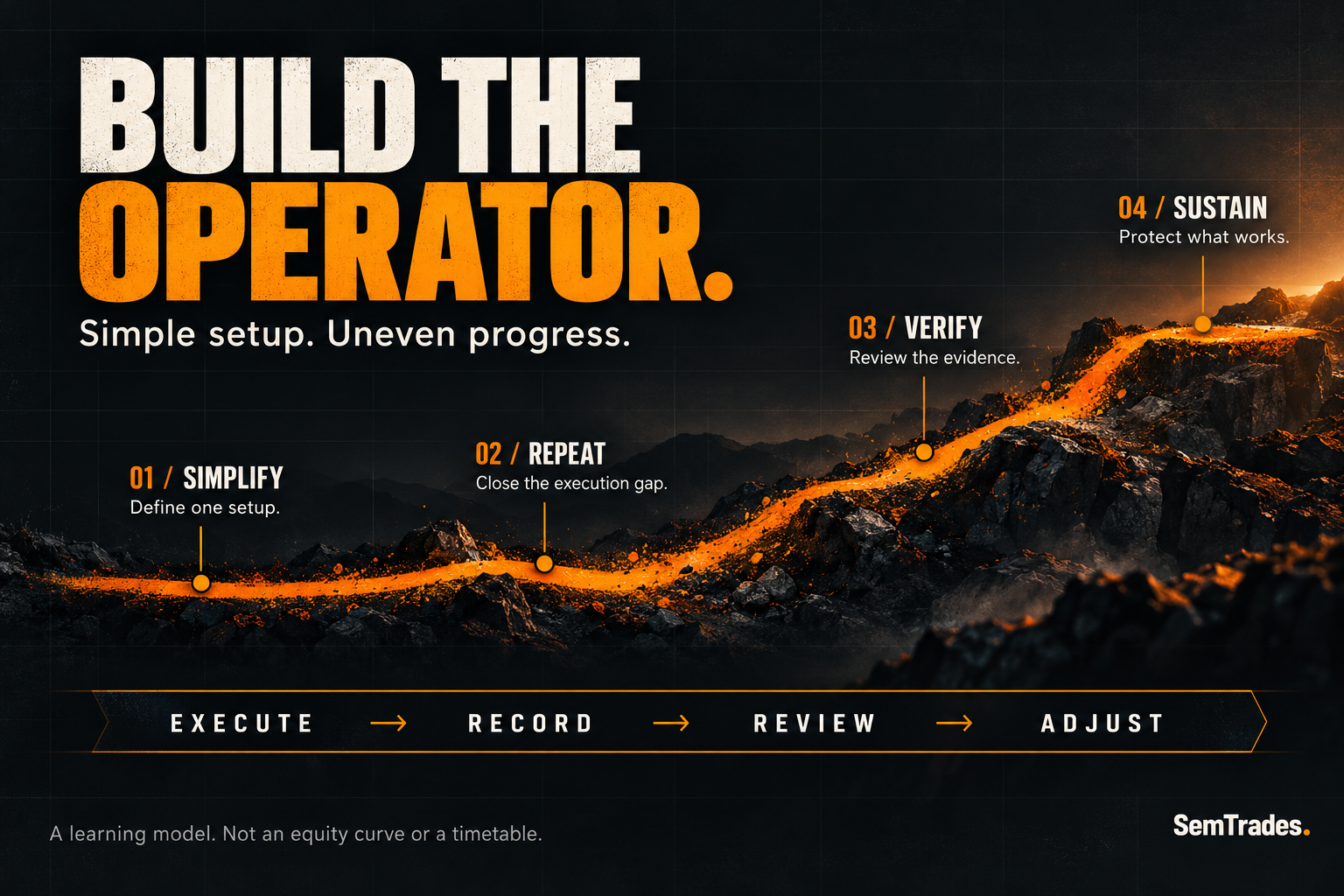
01 / EXPECT DEVELOPMENT, NOT A DEADLINE
Different phases.
Different work.
These are useful descriptions, not ranks to unlock. You can move backwards, overlap phases or stay at a size that fits your life. No phase guarantees profitability.
Stop changing the game.
Every loss sends you looking for another strategy. Size changes with confidence. A winner feels like proof; a loser feels personal.
- The work
- Keep one setup and one written definition. Mark what qualifies, what cancels it and when to pass. Record the decision before the outcome.
- Evidence of progress
- You can explain the entry, invalidation and objective without rewriting the rules afterwards.
Make execution repeatable.
You know the rules, but following them is uneven. A missed entry, a loss or boredom still pulls you away from the plan.
- The work
- Use the same preparation and risk checks. Log the rule breaks as carefully as the trades. Work on one recurring mistake at a time.
- Evidence of progress
- Fewer impulsive entries, steadier risk and the ability to pass. A planned loss stays a planned loss.
Trust the record. Keep questioning it.
The decisions are more consistent. Now the question is whether your actual execution produces a positive result after costs.
- The work
- Review complete batches, including losses. Compare adherence, net R, drawdowns and market conditions. Check whether a few exceptional trades explain most of the result.
- Evidence of progress
- Results hold up across more than a lucky streak. You can distinguish an execution problem from conditions that do not suit the setup.
Grow without losing the process.
More capital changes the euros on the screen. It can also change your behaviour. A bigger account is useful only if you can still operate it.
- The work
- Keep the same risk boundaries. Review any size change against execution, drawdown and real life. Reduce or pause if the bigger numbers start making the decisions.
- Evidence of progress
- The process survives ordinary losses, imperfect decisions and changing conditions. One frustrating trade does not get to dictate the next. There is room to review, recover and have a life outside the chart.
02 / PICK THE WORK IN FRONT OF YOU
What needs
your attention?
Choose the problem you recognise. This gives you a focused review task, not a score or permission to increase risk.
NEXT REP / DEFINE
Write one setup you can actually review.
Mark the location, failure, entry condition, invalidation and objective on a chart before revealing the outcome. Include examples you would pass on. Keep the rule version attached to the record.
At the next review: Could I apply the same definition without changing it to fit the ending?
Study the setup →03 / CLOSE THE LOOP
Execute. Record.
Review. Adjust.
The journal only helps if the review changes something useful. One clear adjustment gives the next batch a question to answer.
- 01
Execute the version.
Keep the setup and risk rules clear. A pass is a valid decision.
- 02
Record what happened.
Save the plan, actual fills, costs, net R and any deviation.
- 03
Separate the causes.
Was it a valid loss, a rule break or a pattern across conditions?
- 04
Change one thing.
State the correction. Date it. Assess it on fresh examples, not just old winners.
A drawdown is information. So is a rule break.
A losing trade inside the plan is not the same as moving a stop, revenge trading or ignoring the risk budget. Repeated breaches are a reason to stop and review. If execution is sound but net results keep deteriorating, reassess the conditions and the method. Discipline alone cannot turn a losing approach into an edge.
My personal ceiling stays around 1% planned risk per idea, with total planned open risk within 1%. Feeling more confident does not create another risk budget. Planned risk is not a guarantee against slippage or larger losses.
04 / KEEP THE WHOLE SYSTEM WORKING
Profitability. Capital.
Freedom.
They are connected, but they are not the same milestone. A sensible return on a learning account can be a small amount of money. Forcing the euros to look impressive by increasing risk changes the process.
A profitable method does not automatically mean an account can fund a life and still grow. Living costs, capital and the pressure to withdraw belong in the decision too. I learned that during nine months of full-time trading.
Compounding needs profits left in the account. Drawdowns and withdrawals matter. The “hockey stick” is a useful metaphor for uneven learning, not a promised equity curve.